• My research focuses on Critical Theory, Philosophy of Religion, and Social and Political Theory.
    Currently, I hold a Knapp Postdoctoral Fellowship at the Vidal Sassoon International Center for the Study of Antisemitism, and a Postdoctoral Fellowship in the ERC-funded Christosemitism Project, directed by Dr. Karma Ben Johanan, at The Hebrew University of Jerusalem.

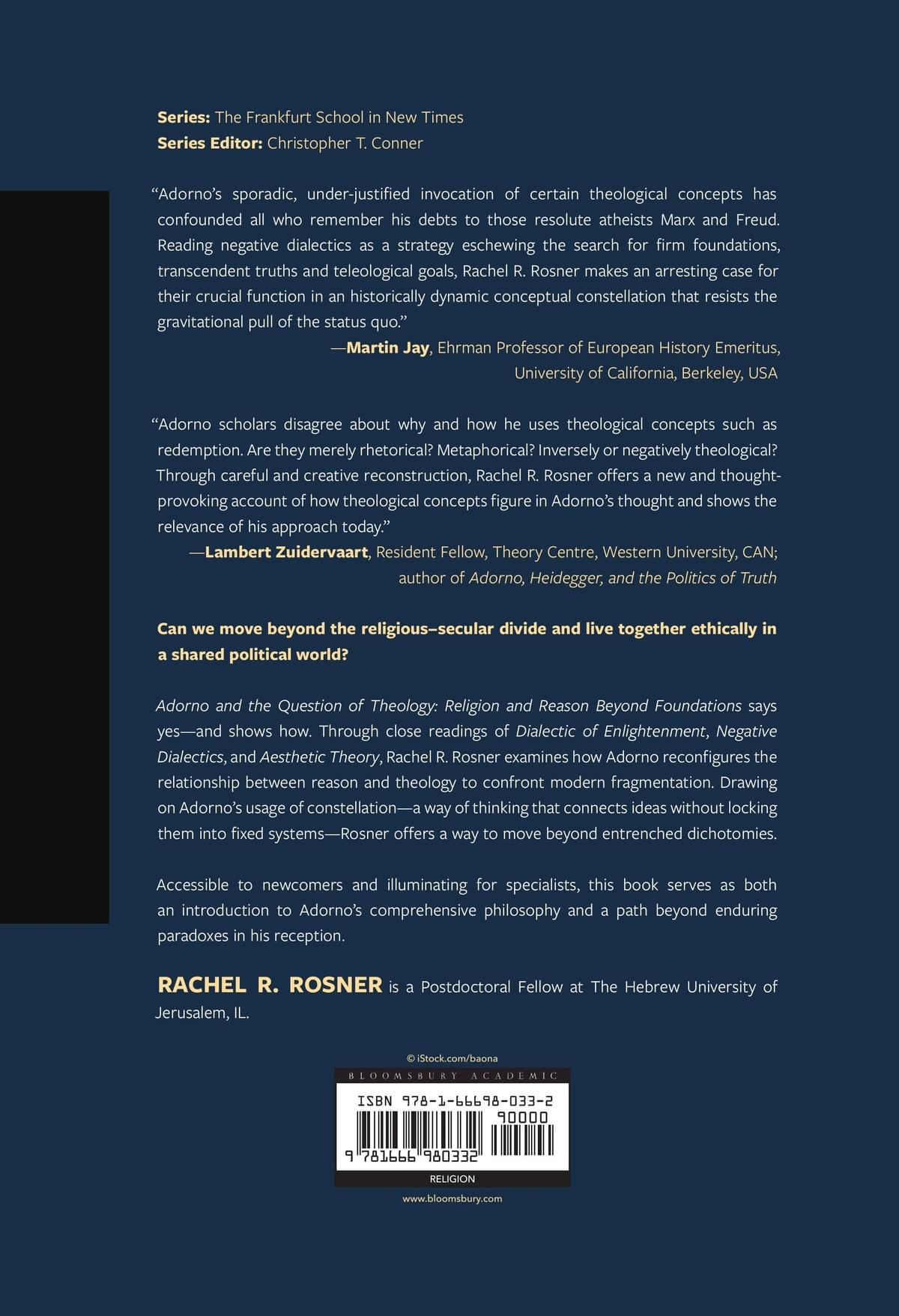
    My forthcoming book, Adorno and the Question of Theology: Religion and Reason Beyond Foundations (Bloomsbury, 2026), examines how the secular–religious divide might be rethought to support a more pluralistic and responsive framework for ethical reasoning.
    In my postdoctoral work, I am developing new research on postsecularism and antisemitism, tracing how religious and secular categories remain bound in modern political discourse, and how we might move beyond reactive positions.

    PhD, Philosophy, Bar-Ilan University (2025)

    MA, Philosophy, Northwestern University

    BA, Philosophy, University of Oregon

  • NEW BOOK

    Available May 28, 2026. Purchase Here: Bloomsbury Academic
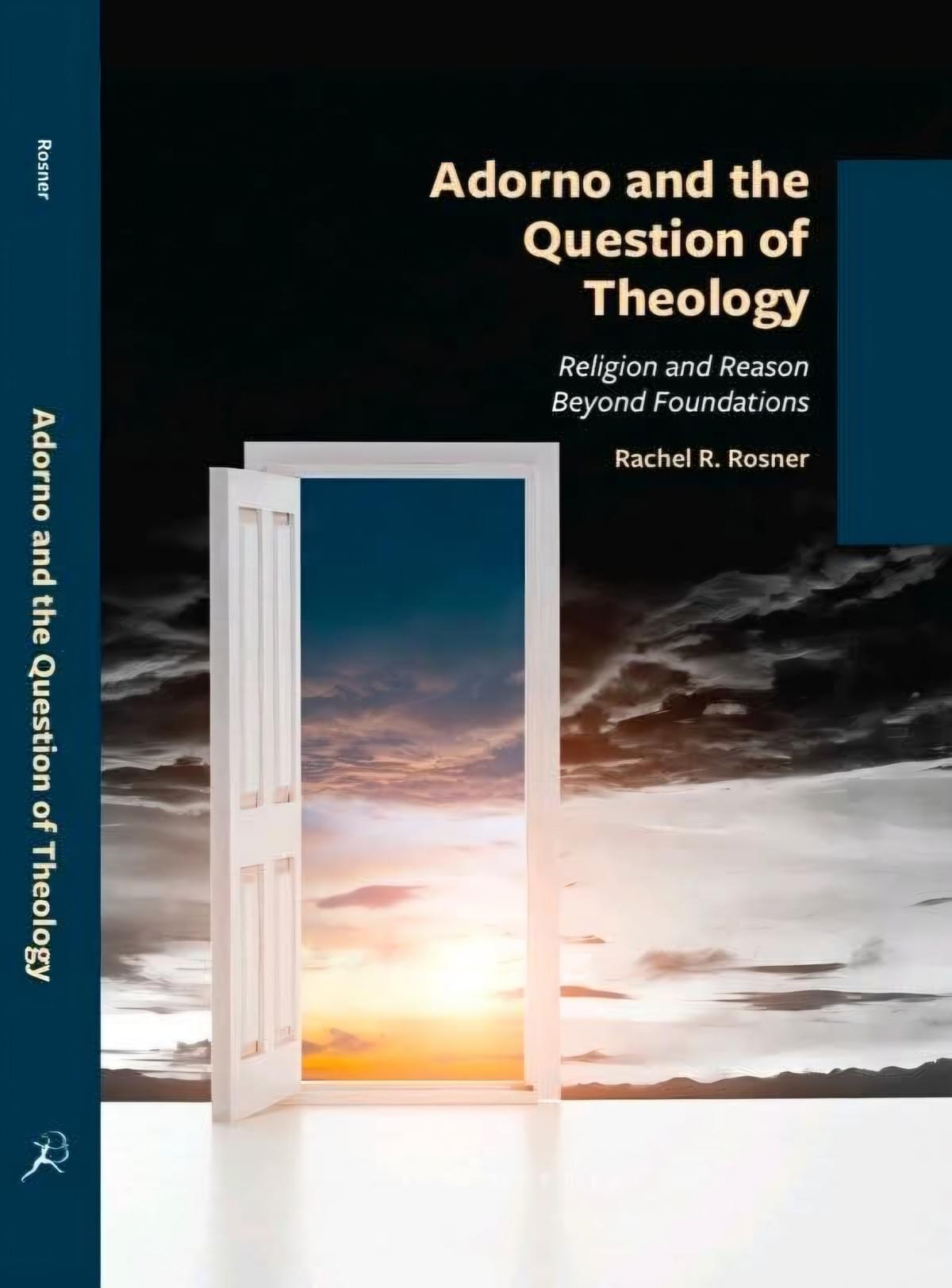
    Adorno and the Question of Theology: Religion and Reason Beyond Foundations

    Can we move beyond the religious–secular divide and live together ethically in a shared political world? Adorno and the Question of Theology: Religion and Reason Beyond Foundations says yesand shows how. Through close readings of Dialectic of Enlightenment, Negative Dialectics, and Aesthetic Theory, Rachel R. Rosner examines how Adorno reconfigures the relationship between reason and theology to confront modern fragmentation. Drawing on Adorno's usage of constellationa way of thinking that connects ideas without locking them into fixed systemsRosner offers a way to move beyond entrenched dichotomies. Accessible to newcomers and illuminating for specialists, this book serves as both an introduction to Adorno's comprehensive philosophy and a path beyond enduring paradoxes in his reception.

    Purchase and learn more at this link.

    Advance Praise

    MARTIN JAY

    “Adorno’s sporadic, under-justified invocation of certain theological concepts has confounded all who remember his debts to those resolute atheists Marx and Freud. Reading negative dialectics as a strategy eschewing the search for firm foundations, transcendent truths and teleological goals, Rachel R. Rosner makes an arresting case for their crucial function in an historically dynamic conceptual constellation that resists the gravitational pull of the status quo.”

    LAMBERT ZUIDERVAART

    “Adorno scholars disagree about why and how he uses theological concepts such as redemption. Are they merely rhetorical? Metaphorical? Inversely or negatively theological? Through careful and creative reconstruction, Rachel R. Rosner offers a new and thought-provoking account of how theological concepts figure in Adorno’s thought and shows the relevance of his approach today.”

  • ARTICLES

    p u b l i s h e d and in p r o g r e s s

    "Postsecular Antisemitism: Adorno, Habermas, and the Frames of Exclusion"

    This article introduces the concept of postsecular antisemitism to name a condition in which prevailing frameworks struggle to register antisemitic harm that operates through the entanglement of religious and secular grammars. It argues that the assumption of normative separability between religious and secular domains, inherited from the secularization thesis and only partially challenged by the postsecular turn, continues to pre-structure what becomes legible within social theory. To develop this argument, the article stages a comparison between early and late Critical Theory. Whereas Horkheimer and Adorno refused to separate religious and secular elements into discrete explanatory domains, Habermas's influential postsecular approach assumes their normative separability even as the secularization prediction is abandoned. Drawing on recent cases of digital antisemitism, which make religious–secular entanglement visible, the article shows the limits of Habermas's procedural model and extends it through a constellational reconstruction of Adorno's approach. The analysis demonstrates how antisemitic harm can be displaced from critical scrutiny through its assignment across the religious–secular divide, clarifying how classificatory distinctions organize a gap between harm and the frameworks meant to register it. In doing so, it opens onto a broader reorientation of social theory beyond inherited assumptions of religious–secular separability.

    "A Model Beyond Foundations: Adorno's Theological Constellation"

    The question of Adorno’s appropriation of theology has moved toward the center of recent scholarship. Leading positions argue that Adorno is an ardent secularist, using theological language only rhetorically; that Adorno’s philosophy is an "inverse theology"; or that Adorno’s philosophy evinces a "negative theology." What is it about Adorno’s philosophy that produces such divergent readings and which, if any, is correct? This article reviews these three influential positions, discusses key elements in Adorno’s philosophy these readings hinge on, and argues that ultimately the logic of the constellation, Adorno’s premier model for his philosophy, undercuts these positions. What’s more, this article suggests the model of Adorno’s theological constellation offers an underappreciated nonfoundationalist framework that shows important promise for critical social theory today.

    "Between Antisemitism and Racism: Adorno after the Religious–Secular Divide"

    In progress

    This paper takes up the recently republished 1962 lecture in which Adorno claims that antisemitism and racism share an "identical structure" (eine identische Struktur). The lecture has divided readers since its republication by Suhrkamp (2024) and first English translation by Polity (2025), with afterwords by Jan Philipp Reemtsma and Peter Gordon staging the split. I argue that the deadlock between universalizing and specifying readings reflects a deeper instability in the religious–secular divide on which both rest.

    "Adorno and the Race–Religion Constellation"

    In progress

    This paper reads Adorno's 1962 lecture alongside recent work in religious studies, critical race theory, and decolonial thought (Asad, Anidjar, Topolski, Mahmood, Wynter) that has developed a model of religious–secular entanglement largely without him. I ask what Adorno's philosophical apparatus contributes to that emerging convergence, and how reading the lecture in light of this scholarship opens his account of antisemitism and racism beyond what standard receptions have allowed.

    "Adorno, Kabbalah, and the Expansion of Enlightenment Reason"

    Conference paper; article in development. Video recording below.

    This paper moves beyond the well-explored questions of how and where Adorno engages with Kabbalistic ideas to ask why they matter for his critical project. I argue these ideas become a crucial point of departure for rethinking the relationship between Enlightenment reason and theological traditions.

    BOOK REVIEWS

    I have published reviews that situate new scholarship within broader debates in philosophy and critical theory, highlighting their relevance for contemporary discussions of ethics, religion, and culture.

    CURRENT RESEARCH TRAJECTORY

    Current work centers on Adorno's 1962 lecture "Fighting Antisemitism Today" and its recent republication (Suhrkamp 2024, Polity 2025), reading it as a site where antisemitism studies and recent scholarship on race, religion, and secular modernity converge on questions about the religious–secular organization of modern exclusion. Two articles in progress develop different facets of this convergence, laying the groundwork for a second book on antisemitism, race, and the religious–secular organization of modernity. Related work on Adorno and Benjamin continues a broader inquiry into critique, temporality, and relation.

  • INTERVIEWS & RECORDINGS

    "Adorno, Kabbalah, and the Expansion of Enlightenment Reason"

    Kabbalah and Modernity Conference
    Yad Ben-Zvi Institute
    December 2025, Jerusalem, Israel

    This paper moves beyond the familiar questions of how and where Theodor W. Adorno engages Kabbalistic ideas to ask what role those ideas play within his critical project. I argue that Kabbalistic and broader theological motifs become a point of departure for rethinking the relationship between Enlightenment reason and theological traditions, expanding prevailing understandings of reason within Critical Theory.

    The talk develops themes that also appear in my book, Adorno and the Question of Theology: Religion and Reason Beyond Foundations (Bloomsbury Academic, May 2026).

    The introduction begins around 45:43 in the recording.